Reno Home Radon Testing: Five Questions Before You Buy
TLDR: Put a radon test question on the Reno home-buying timeline early
Reno home radon testing is a property-specific check, not a neighborhood verdict. Ask about prior results, test placement, who performed the work, and how any elevated result will be handled before your deadlines get tight.
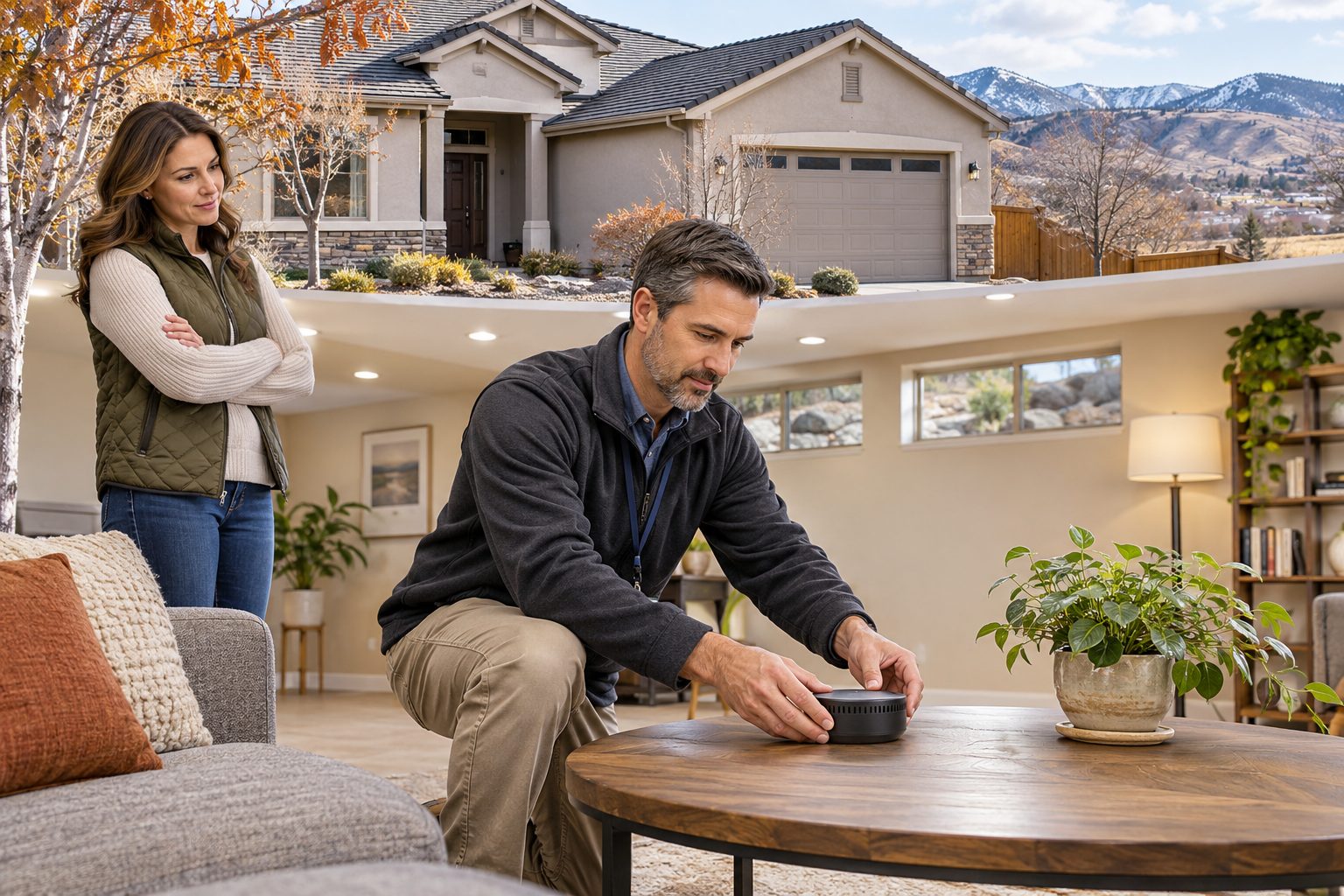
For a Reno or Washoe County buyer, a radon conversation works best as an early due-diligence item. Radon is an invisible gas that can enter buildings from soil, and the Nevada Radon Education Program recommends testing homes rather than assuming an area's general potential predicts one specific house.
The goal is not to turn a test into a reason for alarm. It is to get a reliable result, understand what the result means, and preserve enough time to make a property-specific decision.
Five Reno home radon testing questions to ask before you buy
1. Has this home been tested before?
Ask for the result, the date, the report, and any follow-up documentation. University of Nevada, Reno Extension says a buyer can consider a seller's prior result when it is less than two years old, or request a new test from a certified tester. It also recommends retesting every two years, after an earthquake, and before and after remodeling.
2. Who performed the test and what type of result is it?
For a real estate transaction, UNR Extension recommends an independent certified radon professional. A report should identify the professional and explain the measurement approach, so a buyer is not relying on an unsupported verbal summary.
3. Where was the device placed?
Placement affects whether a result is useful for your planned use of the home. UNR Extension advises testing in the lowest livable level the buyer expects to use, rather than in a kitchen or bathroom. Ask whether that location reflects the rooms you expect to occupy.
4. Were the test conditions followed?
Testing conditions are part of the result. UNR Extension's real-estate checklist calls for a certified professional, a planned two-day test, and closed-house conditions beginning at least 12 hours before testing and continuing during it, with normal entry and exit allowed. If those conditions cannot be confirmed, discuss whether another test is appropriate.
5. What will the agreement say if the result is elevated?
Address the practical questions in writing while there is time: who orders the test, where it is performed, who receives the report, and how the parties will discuss timing and costs if mitigation is considered. UNR Extension recommends raising these decisions early in the home-buying process.
How to read a result without oversimplifying it
The U.S. Environmental Protection Agency recommends taking action to reduce indoor radon at 4 pCi/L or higher and says homeowners should consider reducing levels between 2 and 4 pCi/L. EPA also states that no known level of radon exposure is risk-free. Those are health-protection recommendations, not a prediction of a home's resale value or a substitute for a qualified professional's advice.
A result can lead to more questions about mitigation, timing, documentation, and verification. It does not automatically decide whether a buyer should proceed. The contract terms, the home, the buyer's timeline, and advice from qualified professionals all matter.
Reno and Washoe County: test the house, not the headline
UNR Extension publishes Washoe County-Reno area radon potential information, which can be a helpful starting point for questions. It is not a substitute for testing the actual property. Houses near each other can differ because of foundation design, soil contact, ventilation, remodeling, and how lower levels are used.
Keep the result in the same due-diligence file as inspection findings, repair estimates, and your financing timeline. The Reno buyer roadmap can help organize the larger sequence of property checks and decisions.
FAQ
Does a prior radon test eliminate the need for a new one?
Not necessarily. Review the test date, tester, placement, conditions, and any home changes. UNR Extension says buyers may accept a seller's result that is less than two years old or request a new test from a certified tester.
Is radon testing automatically included in a general home inspection?
Do not assume it is. Confirm the scope of each service and any separate testing arrangement in writing before deadlines approach.
Does a result at or above 4 pCi/L mean the deal must end?
No. EPA recommends taking action at that level, but how a buyer and seller respond depends on the property's facts, contract terms, timeline, and the advice they receive from qualified professionals.
If you are planning a Reno or Washoe County purchase, Bradley Berger can help you build a property-specific due-diligence timeline that keeps testing questions, inspections, and contract deadlines organized.
Data and filters
This article is for: Reno and Washoe County buyers and relocating households evaluating a residential property.
Reporting scope: This is a practical buyer guide, not a market report. It does not estimate local radon prevalence, test results, mitigation costs, property values, or seller obligations.
Sources and methods: University of Nevada, Reno Extension's Nevada Radon Education Program pages were retrieved November 24, 2026 Pacific Time: https://extension.unr.edu/radon/home-buyers.aspx for buyer questions and timing; https://extension.unr.edu/4h/pub.aspx?PubID=2753 for transaction-testing conditions, placement, and independent testing; and https://extension.unr.edu/publication.aspx?PubID=4959 for the availability of Washoe County-Reno area potential information. EPA's action-level guidance, retrieved the same date, was https://www.epa.gov/radon/what-epas-action-level-radon-and-what-does-it-mean. EPA's 4 pCi/L action level and its 2-4 pCi/L consideration range are attributed to EPA and are not presented as a safe threshold, legal requirement, local prevalence estimate, or transaction outcome.